
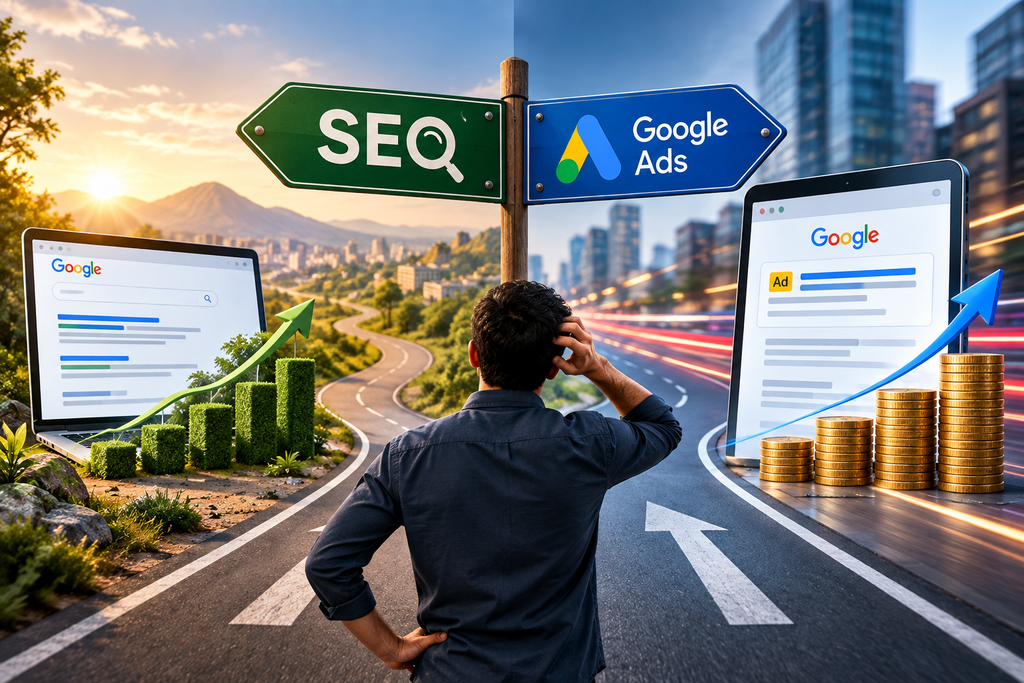
A business owner wants more customers.
That part is simple.
The confusing part usually comes after that.
Someone says, “You should invest in SEO.”
Another person says, “Forget SEO. Run Google Ads and get leads immediately.”
Both sound convincing.
And both can work.
But SEO and Google Ads are not the same thing. They work differently, require different levels of investment and fit different business situations.
The better question is not really “Which one is better?”
It is:
“What does my business need right now?”
A local restaurant, a construction company, an online store and a B2B software company may all use Google, but their marketing requirements are completely different.
Understanding that difference can help you decide where your time and money should go.
First, what does SEO actually do?
SEO stands for Search Engine Optimization.
In simple terms, it is the work involved in improving a website so that it can appear more prominently in organic search results.
Imagine someone in Coimbatore searches for:
“best catering services in Coimbatore”
There are paid advertisements that may appear around the search results. There are also organic results.
SEO focuses on improving your chances of appearing in those unpaid search results.
That work can involve many things.
Your website structure matters.
The quality of your content matters.
Technical issues matter.
The relevance of your pages matters.
Links and the reputation of your website can matter too.
For a local business, things such as your Google Business Profile and local relevance also become important.
SEO is therefore not one activity.
It is more like maintaining and improving a website over time.
And what exactly are Google Ads?
Google Ads works differently.
Instead of waiting for your website to earn organic visibility, you pay to advertise on Google’s advertising network.
For example, if you run a plumbing service in Coimbatore and someone searches for a relevant service, your advertisement may appear when your campaign is eligible for that search.
You choose a budget and campaign settings.
Depending on the campaign, you may pay based on clicks, impressions or other actions.
The exact cost varies considerably.
Some keywords can be relatively inexpensive.
Others can be expensive because many businesses are competing for the same audience.
That competition is one reason why simply saying “Google Ads is cheap” or “Google Ads is expensive” does not tell the whole story.
SEO and Google Ads solve different problems
This is where the comparison becomes easier.
Think about a new business that has just launched a website.
The owner wants enquiries this month.
SEO may be useful for the long-term search strategy, but a new website normally needs time to build organic visibility.
Google Ads can put an eligible advertisement in front of people searching for relevant terms much sooner.
Now consider a business that has been operating for several years.
It receives consistent organic traffic and gets enquiries from Google without paying for every visit.
That business may have built a valuable SEO asset.
The two situations are completely different.
One is looking for immediate visibility.
The other has already invested in long-term organic visibility.
SEO is a long-term game
This is probably the biggest difference between the two.
SEO generally takes time.
You may publish a useful service page today.
That does not mean it will suddenly reach the top of Google tomorrow.
Search visibility depends on many factors, including competition, the quality and relevance of the page, the website itself and how search engines evaluate the content.
This can be frustrating for business owners.
You spend money on content and technical work, but the results may not appear immediately.
That does not necessarily mean the work has failed.
SEO often works gradually.
A page begins receiving impressions.
It appears for a few relevant searches.
It moves for some queries.
More people discover the website.
The business publishes additional useful content.
Over time, the website can build stronger organic visibility.
That is very different from advertising.
Google Ads can give you faster visibility
With Google Ads, you do not have to wait for an organic ranking before showing an advertisement.
If the campaign is properly set up and eligible to serve, your advertisement can appear for relevant searches soon after the campaign starts.
That can be useful when a business has an immediate requirement.
Imagine a wedding catering company has availability for several upcoming dates.
Waiting months for SEO traffic may not solve the immediate problem.
A carefully planned Google Ads campaign could be tested for relevant searches and locations.
The business can then measure the enquiries and decide whether the campaign is producing worthwhile results.
There is still no guarantee that every click becomes a customer.
That depends on the keyword, advertisement, offer, landing page, sales process and several other factors.
But the visibility itself can be obtained much faster than waiting for a new organic page to gain traction.
What happens when you stop paying for Google Ads?
This is another important difference.
Suppose you spend ₹1,000 a day on Google Ads.
Your advertisements are running and receiving eligible traffic.
Then you stop the campaign.
The paid traffic associated with that campaign generally stops as well.
That is the nature of advertising.
SEO is different.
If you build a useful page and it earns organic visibility, that page can continue attracting visitors without paying for each individual click.
That does not mean SEO is free.
There are costs involved in research, content, technical work, design, development and ongoing maintenance.
But you are building an organic search asset rather than renting visibility through an advertisement.
Does SEO cost less than Google Ads?
This question comes up often.
There is no universal answer.
SEO has costs.
You may need a content writer.
You may need an SEO specialist.
Technical improvements may require a developer.
Good photography, design or video may also be useful.
Google Ads has advertising spend, along with the cost of managing and optimising campaigns.
A business could spend ₹500 a day on ads or ₹50,000 a month. Another business may spend considerably more.
SEO also varies greatly depending on the industry and competition.
A small local business targeting a limited geographic area has different requirements from a company competing nationally for highly competitive keywords.
So instead of asking:
“Which one is cheaper?”
Ask:
“What am I getting from the money I spend?”
That is a much more useful business question.
SEO can build visibility around many searches
One advantage of a good SEO strategy is that your website can attract visitors through many different searches.
For example, a construction company might have pages and articles around:
- House construction in Coimbatore
- Residential builders
- Villa construction
- Construction costs
- Home building guides
- Choosing a builder
- Construction materials
- Project planning
A useful website can potentially receive organic visitors from a range of related searches.
Google Ads can also target multiple keywords, but each campaign still involves advertising spend.
SEO gives a business the opportunity to build a broader organic presence over time.
Google Ads gives you more control over targeting
Paid search has another useful advantage.
You can control many aspects of a campaign.
Depending on the campaign setup, you can choose things such as:
- Location
- Budget
- Keywords or audiences
- Ad schedules
- Landing pages
- Conversion goals
For a local business, location can be particularly important.
A catering company serving Coimbatore may not want to spend its entire advertising budget showing ads to people searching from another state.
Likewise, a business offering a service only in certain areas needs to think carefully about where its advertisements should appear.
Good campaign setup matters.
Simply adding money to an account does not automatically create a successful campaign.
What about trust?
This is an interesting part of the SEO and Google Ads discussion.
Some people immediately recognise an advertisement as paid placement.
Others do not care whether a result is paid or organic as long as it answers their question.
There is no single customer reaction.
What matters more is what they find after clicking.
If your advertisement takes someone to a slow website with unclear information, the campaign may struggle.
If your organic result takes them to a thin page that does not answer their question, SEO will not magically solve that problem either.
Visibility gets the person to your website.
The website still needs to do its job.
Your landing page matters more than many businesses realise
This applies particularly to Google Ads.
Suppose you advertise:
“Wedding Catering Services in Coimbatore”
The person clicks the advertisement.
Instead of seeing information about wedding catering, they land on a generic homepage with ten unrelated services.
That creates unnecessary friction.
A dedicated page can be much more useful.
It can explain the service, show photographs, mention relevant details and give the visitor a clear way to enquire.
The same principle applies to SEO.
If someone searches for a specific service and lands on a page that actually discusses that service, the experience is much better.
This is why marketing and website strategy should not be treated as separate activities.
SEO is useful for businesses with informational searches
Some businesses have customers who research heavily before making a decision.
Think about:
- Construction
- Healthcare
- Education
- Software
- Financial services
- Professional consulting
- Real estate
A potential customer may not call immediately.
They may search several questions first.
For example:
How much does it cost to build a house in Coimbatore?
What should I check before choosing a builder?
How long does house construction take?
A business that creates genuinely useful content around these questions has an opportunity to become part of that research process.
That is where SEO and content marketing can work together.
Google Ads can be useful for high-intent searches
Some searches show clear buying intent.
Consider someone searching:
“emergency AC repair near me”
That person may not want to read a 2,000-word article.
They may simply want to call someone.
A relevant paid search campaign can make sense in situations like this because the customer is already looking for a service.
Again, the campaign still needs to be managed properly.
A high-intent keyword does not guarantee a sale.
But the search itself can tell you something about what the person wants.
What if your business is new?
This is where many business owners struggle.
You have a new website.
Nobody knows your company yet.
There are no rankings.
There are very few backlinks.
You have almost no organic traffic.
But you need enquiries.
A combination can make sense.
Use paid advertising to test the market and generate visibility while building your organic presence at the same time.
The advertising can also teach you something.
Which services receive enquiries?
Which messages attract clicks?
Which locations respond?
Which keywords seem relevant?
Those observations can later help shape your wider marketing strategy.
What if your business already gets organic traffic?
The situation changes.
Suppose your website receives thousands of relevant visitors every month through organic search.
You have useful service pages and your content brings people to the site regularly.
In that situation, SEO is already contributing something valuable.
That does not automatically mean Google Ads should be stopped.
Paid advertising can still be used for specific services, locations, promotions or competitive searches.
The point is that the two channels do not have to fight each other.
They can support different parts of the same marketing plan.
Can you use SEO and Google Ads together?
Absolutely.
In fact, many businesses do.
Think of them as two different routes to the same website.
SEO works on the organic route.
Google Ads provides paid visibility.
A business might use SEO to build long-term search presence while using Google Ads for services where immediate enquiries are important.
There is another useful advantage.
You can compare what happens in both channels.
Which search terms bring useful visitors?
Which pages generate enquiries?
Which services convert better?
Which locations respond?
The answers can help you make better marketing decisions.
A simple example
Imagine you run a catering company in Coimbatore.
You offer wedding catering, corporate catering and private event catering.
You start Google Ads for wedding catering because you want enquiries for upcoming events.
At the same time, you work on SEO.
You create a detailed wedding catering page.
You publish useful articles about wedding menu planning.
You add real photographs from events.
You improve your local search presence.
You collect genuine customer reviews.
The advertising can help you reach people now.
The SEO work helps build an organic presence that may continue bringing relevant visitors later.
Neither activity replaces the other.
They simply work on different timelines.
So, which one should you choose?
There is no universal answer.
If you need faster visibility, Google Ads may be useful.
If you want to build long-term organic search visibility, SEO may be important.
If you have a limited budget, the decision should depend on your business model, competition, customer journey and expected return.
And sometimes the answer is not either-or.
You may need both.
A local service business could use Google Ads for immediate lead generation while gradually building SEO.
An established company with strong organic visibility may use paid search selectively.
A new business may start with a small paid campaign while investing in the website and content needed for future organic growth.
The right mix depends on the business.
SEO vs Google Ads: A Quick Comparison
| Area | SEO | Google Ads |
|---|---|---|
| Visibility | Organic search | Paid advertising |
| Speed | Usually takes time | Can provide faster visibility |
| Payment | Investment in website, content and optimisation | Advertising spend |
| Long-term value | Can build lasting organic visibility | Traffic generally depends on active campaigns |
| Control | Less direct control over rankings | More control over campaign settings |
| Content | Very important | Useful for landing pages and ad relevance |
| Local businesses | Useful for local search | Useful for targeted local campaigns |
| Best suited for | Long-term search presence | Immediate or campaign-specific visibility |
This table should not be read as one being universally better.
They are simply different tools.
Before Spending Money, Fix the Basics
There is one thing I would recommend to almost any business owner considering either channel.
Look at the website first.
If your website is slow, confusing or difficult to use, sending more people to it may not solve the underlying problem.
Check the basics.
Can someone understand your service within a few seconds?
Are your contact details easy to find?
Does the website work properly on mobile?
Are your service pages useful?
Is there a clear way to enquire?
Do your photographs and content represent the actual business?
These things matter whether the visitor comes from Google Ads or organic search.
Measure Leads, Not Just Clicks
This is where marketing becomes a business activity rather than simply a traffic exercise.
Getting 1,000 visitors sounds impressive.
But what if only one person enquires?
Another campaign might bring 200 visitors and generate 20 useful enquiries.
The second campaign may be more valuable to the business even though the traffic number is smaller.
Track things such as:
- Enquiries
- Phone calls
- WhatsApp conversations
- Form submissions
- Bookings
- Sales
- Cost per lead
- Revenue generated
The exact metrics depend on the business.
But the basic principle is the same:
Do not stop at measuring traffic. Follow the customer journey.
Final Thoughts
SEO and Google Ads are often presented as competitors.
They do not have to be.
SEO can help a business build organic search visibility over time.
Google Ads can provide paid visibility when a business wants to reach relevant searches through advertising.
One usually needs patience.
The other needs an ongoing advertising budget.
One can help build an organic search asset.
The other gives you more direct control over where and when your advertising appears.
For many businesses, the most practical approach is to understand what each channel can do and use them according to the business goal.
If you need customers this month, paid search may deserve attention.
If you want your website to become a stronger source of organic traffic over the coming years, SEO deserves attention too.
And if your business has room for both, there is no reason to treat the two as an either-or decision.
SEO builds your organic presence. Google Ads buys targeted visibility. Your business needs to decide how those two pieces fit into its own growth plan.
Frequently Asked Questions
Is SEO better than Google Ads?
Neither is automatically better. SEO and Google Ads work differently. SEO focuses on organic search visibility, while Google Ads provides paid advertising opportunities. The right choice depends on your business goals, competition, budget and customer journey.
How long does SEO take to show results?
There is no fixed timeframe. A new website may take time to establish organic visibility, while an established website with good authority and relevant content may see changes sooner. Results depend on the market and the work being done.
Can Google Ads give immediate leads?
Google Ads can provide faster visibility than waiting for organic rankings, but visibility does not guarantee leads. Keywords, advertisements, landing pages, location targeting, competition and the sales process all affect the outcome.
Should a new business start with SEO or Google Ads?
A new business can consider both. Google Ads can be tested when immediate visibility is needed, while SEO work can build the website’s organic presence over time.
Can SEO and Google Ads be used together?
Yes. Many businesses use paid advertising for specific campaigns or high-intent searches while continuing to build organic search visibility through SEO.
Which is more expensive, SEO or Google Ads?
There is no fixed answer. Google Ads requires advertising spend, while SEO involves costs related to strategy, content, technical work and ongoing optimisation. The right comparison is the cost against the business results each channel produces.
Is SEO free?
No. Organic clicks do not carry the same per-click advertising charge as Google Ads, but SEO still requires investment in content, technical improvements, research and ongoing work.
Будьте в курсе за интересными событиями игровой индустрии вместе с нашим разделом новостей. Здесь мы разбираем ожидаемые премьеры, новые трейлеры, даты выхода игр, патчи, дополнения и события киберспорта. Читайте без задержек о рейтинг казино-онлайн для ПК, консолей и мобильных устройств: от крупных блокбастеров до необычных инди-игр. Вы найдёте материалы о том, что действительно обсуждают игроки, какие новинки готовятся к релизу и какие изменения уже появились в любимых играх.