
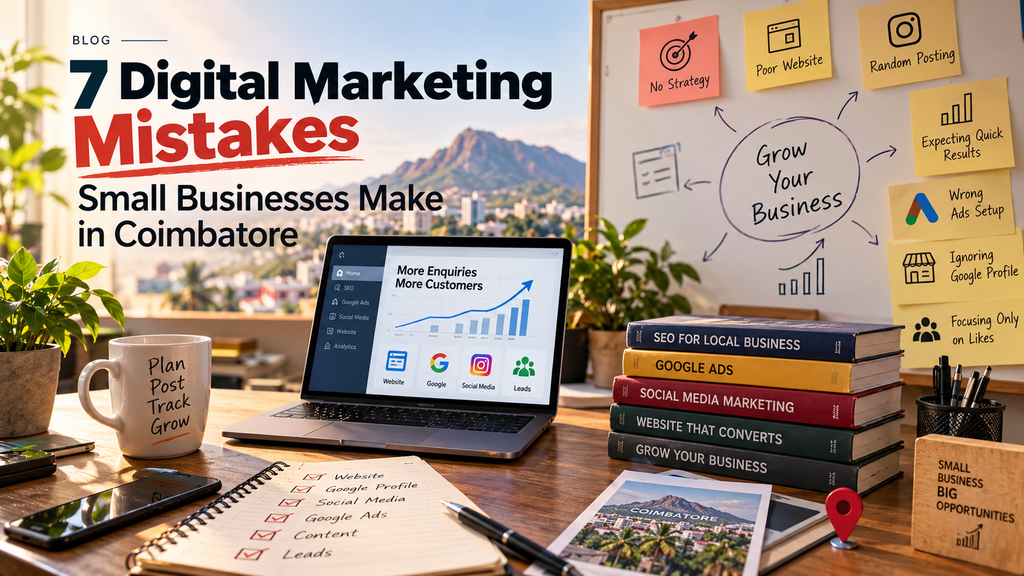
Running a small business in Coimbatore is not always easy.
You have customers to deal with, staff to manage, suppliers to follow up with and a hundred other things that need your attention. Marketing usually gets squeezed somewhere in between all of that.
Then one day, you notice a competitor getting enquiries through Google.
Another business is posting regularly on Instagram.
Someone else seems to be getting good reviews.
So you decide to start digital marketing too.
You create a website, open social media accounts and perhaps run a few advertisements.
After a few weeks, the question comes up:
“Why am I still not getting enough enquiries?”
In many cases, the problem is not that digital marketing does not work.
The problem is how it is being approached.
I have seen small businesses make some of the same mistakes again and again. They are not always big technical mistakes. Sometimes they are very simple things that get overlooked while everyone is busy trying to get more customers.
Here are seven of them.
1. Trying to Be Everywhere at Once
One of the first things a business owner often hears is:
“You need Facebook.”
“You need Instagram.”
“You need YouTube.”
“You need Google.”
“You need a website.”
Soon there are five different platforms to manage, and nobody has enough time to maintain any of them properly.
A small business does not necessarily need to be active everywhere.
Think about where your customers actually spend their time.
A local catering company may get more value from Google Search, Google Business Profile, Instagram and WhatsApp.
A B2B company may find LinkedIn and Google more useful.
A fashion store may naturally depend more on Instagram.
The goal is not to collect social media accounts.
The goal is to reach the right people.
It is better to maintain two channels properly than create six accounts and abandon half of them after a few weeks.
2. Treating the Website Like an Online Visiting Card
This is very common.
A business creates a website because “everyone needs a website.”
The website has a home page, an About Us page, a Services page and a Contact page.
Everything looks neat.
But there is one problem.
It does not actually help the visitor decide what to do next.
Someone searching for a catering service does not simply want to know that your company exists.
They may want to know:
What type of catering do you provide?
Which areas do you serve?
What kind of events do you handle?
Can I see your previous work?
How can I contact you?
The same applies to almost every industry.
A website should answer the questions your potential customer is already asking.
It should not simply exist because a business card has been converted into a website.
3. Posting on Social Media Without a Reason
“Today is Monday. We need to post something.”
This is not really a social media strategy.
But many small businesses operate exactly like this.
Someone opens Canva, creates a graphic, adds the logo and posts it.
Next week, the same thing happens again.
After a few months, there may be dozens of posts but very little connection between them.
Before creating a post, ask a simple question:
Why should someone care about this?
Maybe you want to show a completed project.
Maybe you want to answer a common customer question.
Maybe you want to introduce a service.
Maybe you want to show what happens behind the scenes.
Maybe you have something genuinely useful to teach.
Not every post needs to sell something.
Sometimes showing how you work is enough.
A construction company can show the progress of a project.
A restaurant can show how a dish is prepared.
A wedding planner can show a venue before and after decoration.
These posts give people a reason to stop scrolling.
4. Expecting Immediate Results From SEO
SEO is one of those things that sounds simple until you actually start doing it.
A business owner chooses a few keywords, adds them to the website and expects Google rankings to appear quickly.
That is usually not how it works.
If you are targeting a competitive search such as “digital marketing company in Coimbatore”, there are already many websites competing for that visibility.
Google needs to understand your website.
Your pages need to be useful.
Your content needs to match what people are searching for.
Technical issues may need attention.
Local signals can matter for local businesses.
And the website needs time to build credibility.
SEO can be valuable, but it needs patience.
If you publish one page today and check Google tomorrow, you are probably going to be disappointed.
Give the work enough time to show what it can do.
5. Running Google Ads Without Fixing the Website First
This one can become expensive.
A business starts a Google Ads campaign.
The advertisement looks good.
People click.
Money is being spent.
But the landing page is confusing.
The phone number is difficult to find.
The service information is incomplete.
There are no clear photographs.
The enquiry form asks too many questions.
The visitor leaves.
Then the business owner says:
“Google Ads is not working.”
Sometimes the problem is not the advertisement.
The advertisement did its job. It brought someone to the website.
What happened after the click is the next question.
Before increasing an advertising budget, check the page where customers are landing.
Can they understand the offer quickly?
Can they trust the business?
Can they contact you without searching around?
A better landing page can make a significant difference to the same advertising traffic.
6. Ignoring Google Business Profile
For a local business, this can be a big missed opportunity.
Someone in Coimbatore searches for a service near them.
Google may show local business listings along with the map.
This is often one of the first places a potential customer sees a local company.
Yet some businesses barely maintain their profile.
The address may be outdated.
Opening hours may be wrong.
Photographs may be several years old.
Services may not be properly listed.
Customer questions may be unanswered.
Reviews may be left without responses.
A Google Business Profile should not be treated as something you create once and forget.
Keep the basic information accurate.
Add genuine photographs.
Keep the services updated.
Pay attention to customer reviews.
For a local business, these small details can matter.
7. Looking Only at Likes and Followers
This is probably one of the easiest traps to fall into.
A post gets 200 likes.
Everyone feels happy.
Another post gets only 40 likes.
Someone says, “This post did not work.”
But what if that second post brought three genuine enquiries?
And the post with 200 likes brought zero customers?
For a business, those numbers tell two very different stories.
Likes and followers are useful metrics, but they are not the whole picture.
Look at what happens after someone interacts with your marketing.
Are people calling?
Are they sending WhatsApp messages?
Are they filling out forms?
Are they visiting the store?
Are they asking for quotations?
Are they actually buying?
The answer depends on the type of business.
A local service company may care much more about enquiries than likes.
Marketing should eventually connect back to the business.
One More Thing: Do Not Copy What Another Business Is Doing
There is nothing wrong with looking at competitors.
It is actually useful.
You can see how they present their services, what kind of content they publish and how they communicate with customers.
But copying everything they do can create another problem.
Their strategy was built for their business.
Their customers may be different.
Their budget may be different.
Their strengths may be different.
Their website may have been online for years.
You do not know the entire story simply by looking at their Instagram page.
Take ideas from the market, but build your own approach around your business.
What Should a Small Business Do Instead?
You do not need a huge marketing team to start improving your digital presence.
Start with the basics.
Make sure your website clearly explains what you offer.
Keep your Google Business Profile accurate.
Choose the platforms where your customers actually spend time.
Create content that gives people a reason to pay attention.
If you use Google Ads, send visitors to useful landing pages.
If you are investing in SEO, give it enough time.
And measure enquiries and sales instead of looking only at traffic and social media numbers.
It sounds simple.
That is because it is.
The difficult part is doing these things consistently.
Final Thoughts
Digital marketing can be useful for a small business in Coimbatore, but it is not a magic button.
You cannot create an Instagram account today and expect hundreds of customers tomorrow.
You cannot publish five blog posts and assume Google will immediately send traffic.
You cannot spend money on advertisements and expect every visitor to become a customer.
Marketing works better when the different pieces support each other.
Your website should make sense.
Your Google presence should be maintained.
Your content should have a purpose.
Your advertisements should lead people to useful pages.
And your marketing numbers should eventually connect to real business results.
If you are making some of these mistakes right now, that does not mean your digital marketing has failed.
It simply means there is something to fix.
Small improvements, done consistently, can make a much bigger difference than constantly changing your marketing strategy.
fEbMxrnDQIsgLdbiHvty
Мечтаешь смотреть эротические видео в хорошем качестве anal porno тогда заходи бесплатно без регистрации и без смс